
Calculating Food Portions for 50 Guests: A Connoisseur’s Guide to Flawless Event Catering

What if the true measure of a successful evening isn't the laughter in the room, but the precise weight of the Szechwan Fried Rice left in the buffet tray? Many hosts find themselves caught in a cycle of portioning anxiety, terrified that a guest might reach for a piece of Tandoori Chicken only to find an empty platter. It's a common fear, but calculating food portions for 50 guests doesn't have to be a guessing game based on nerves, particularly when you are upholding the high standards of professional halal catering.
You likely already know that a generous spread is the hallmark of true hospitality, yet balancing the rich, velvety textures of Butter Chicken with the lighter, aromatic volume of Chindian fusion requires a connoisseur's eye. This guide promises to transform that uncertainty into absolute confidence. We'll provide you with a masterclass in scaling your menu, from the exact count of Garlic Naan required to the perfect ratio of vegetarian Paneer Butter Masala versus a fragrant Lucknowi Mutton Biryani. By the end, you'll have a clear, expert-led roadmap to ensure a seamless flow and a bountiful table that leaves every guest feeling like a cherished dignitary.
Key Takeaways
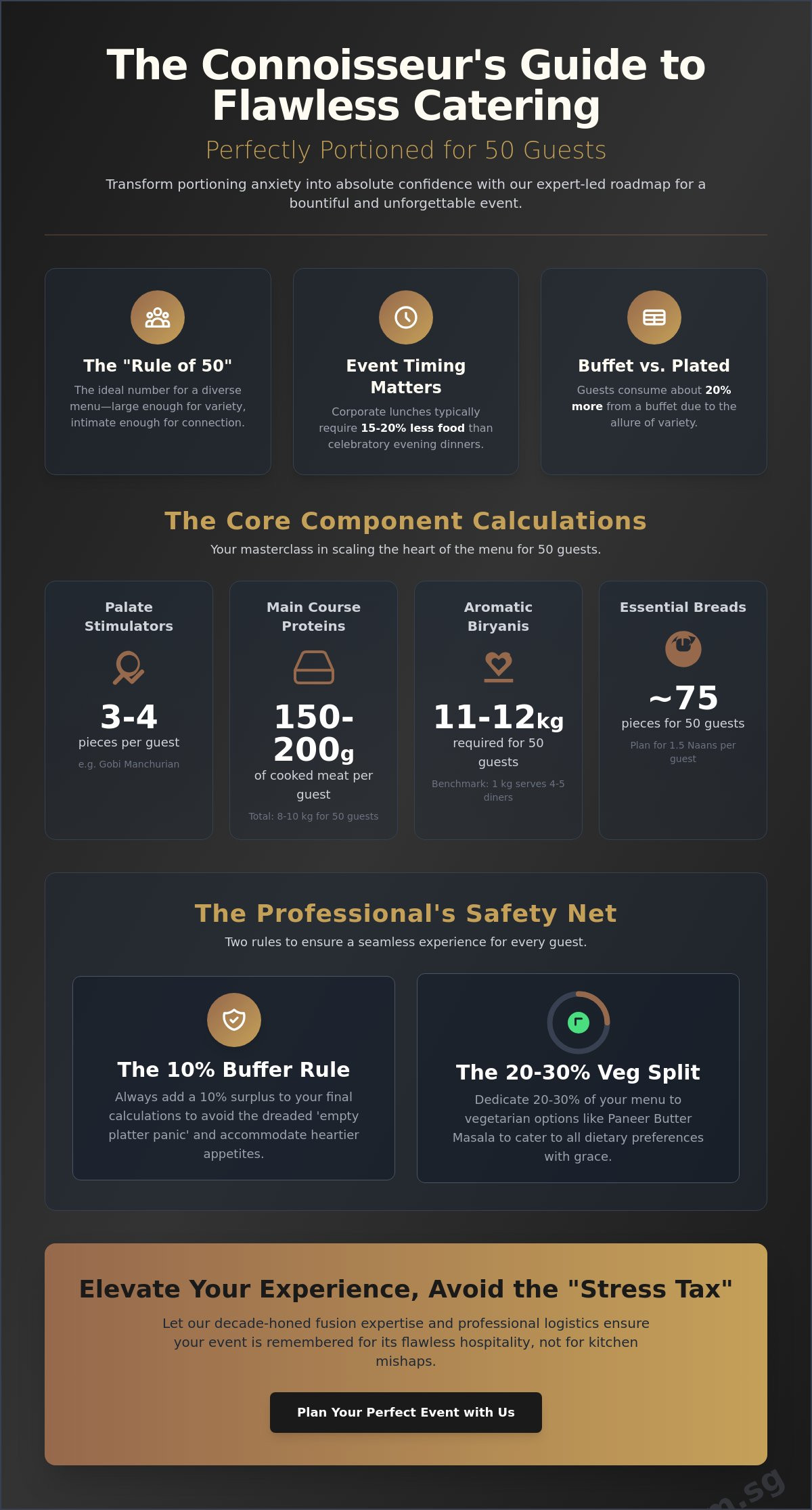
Learn the "Rule of 50" to strike a perfect balance between intimate dining and buffet variety when calculating food portions for 50 guests.
Discover why one kilogram of aromatic Lucknowi Mutton Biryani typically serves four to five diners, providing a reliable benchmark for your main course planning.
Master the "palate stimulator" strategy by portioning Chindian starters like Gobi Manchurian at three to four pieces per person to excite the senses without overwhelming the appetite.
Ensure a seamless experience by applying the professional 10% buffer rule and maintaining a 20-30% vegetarian split to accommodate all dietary preferences with grace.
Understand the hidden logistical advantages of professional halal catering to avoid the "stress tax" of DIY while elevating your event with decade-honed fusion expertise.
Table of Contents
The Art of Estimating: Why 50 Guests is the 'Sweet Spot' for Event Planning
The Core Components: Calculating Proteins, Biryanis, and Breads for 50
Beyond the Main: Portioning Starters, Sides, and the 'Chindian' Fusion Factor
Avoiding the 'Empty Platter' Panic: Buffers, Dietary Requirements, and Wastage
Elevating the Experience: Why Professional Halal Catering Outshines DIY
The Art of Estimating: Why 50 Guests is the 'Sweet Spot' for Event Planning
There is a certain magic to the number fifty. In the world of hospitality, it represents the "Rule of 50," the exact threshold where a charming DIY gathering transforms into a complex logistical operation. Calculating food portions for 50 guests is often the moment a host realises that domestic kitchen equipment and personal energy levels have reached their limit. This is where professional logistics truly shine, as a group of this size requires a level of consistency that only a commercial kitchen can provide. While you might manage to sauté a few portions of Chilli Chicken at home, preparing enough for fifty hungry guests while maintaining the crispness of the batter and the zing of the Szechwan spices is an entirely different craft.
The psychology of a 50-person crowd is fascinating. It is large enough to feel like a significant celebration, yet small enough to retain a sense of intimacy. This "sweet spot" allows you to offer a wider flavour profile without the risk of excessive waste. With fifty guests, you can comfortably introduce variety, such as pairing a rich, creamy Dal Makhani with a vibrant Gobi Manchurian. Smaller groups often force you to limit your menu to avoid massive leftovers, but fifty guests provide the volume necessary to sustain a diverse buffet that caters to every palate. In our local social context, we must also account for the "Singaporean buffer." We are a culture that expresses love through abundance, so our portions must reflect a slightly higher consumption rate to ensure the table remains a welcoming sight from the first guest to the last.
Understanding Guest Profiles and Appetite
A connoisseur knows that the guest list is more than just a headcount; it is a map of appetites. Assessing the ratio of adults to children is vital, as it dictates the heat levels of your Chicken Tikka Masala and the quantity of milder sides like Garlic Naan. The time of day also plays a significant role. A midday corporate lunch typically sees a 15-20% decrease in portion requirements compared to a celebratory dinner, where guests tend to linger and return for second helpings. Equally, a four-hour wedding requires a more robust volume of food than a one-hour seminar, as the duration of the event naturally encourages more grazing.
Buffet vs Plated: The Portioning Divide
The style of service dramatically alters the serving size and total volume required. In a buffet setting, guests typically consume about 20% more than they would with a plated meal. This is largely due to the "first-look" effect. When guests see a magnificent spread of Tandoori Chicken and Szechwan Fried Rice, the visual abundance triggers a desire to sample everything on offer. To maintain control over these portions, we often recommend a clever layout or employing professional service staff. Our professional catering services ensure that while the sense of plenty remains, the distribution is managed with grace, preventing a shortage of popular items like Lucknowi Mutton Biryani before the end of the service.
The Core Components: Calculating Proteins, Biryanis, and Breads for 50
A true culinary journey begins with the heart of the table, where the balance of textures and temperatures defines the experience. When calculating food portions for 50 guests, the protein serves as the anchor of your menu. For a multi-dish spread, we typically aim for 150g to 200g of cooked meat per diner. This ensures that even with several choices, no one leaves wanting. If you're serving a rich Mutton Rogan Josh alongside a creamy Butter Chicken, the variety allows for slightly smaller portions of each, yet the total volume must remain generous to satisfy a discerning crowd. The goal is to create a sense of abundance that feels curated rather than overwhelming.
Main Course Meat Mathematics
For a single-protein main, you'll need roughly 8-10kg of meat. It's a delicate science. When preparing dishes like Chicken Tikka Masala, you must adjust for the weight loss during the tandoor roasting process. Boneless cuts are more efficient for portioning, while bone-in options offer a nostalgic, traditional depth of flavour but require a higher raw weight to account for the bone. The ideal meat-to-sauce ratio for professional catering in 2026 balances 60% succulent protein with 40% rich, flavour-concentrated gravy to ensure every guest enjoys a consistent experience.
Starch and Grains: The Foundation of the Feast
Grains are the canvas upon which the curries paint their story. Planning food for 50 guests requires an understanding of how rice expands during the cooking process. We suggest 3-4kg of dry Basmati rice for a group of this size. If the centrepiece is our Lucknowi Mutton Biryani, the calculation shifts; one kilogram typically serves four to five guests in a buffet setting. Offering both rice and hand-stretched Garlic Naan is a wise choice, as it allows guests to customise their meal while naturally reducing the volume needed for any single starch. For portioning for 50, our expert menu planning team can help you strike the perfect balance between variety and volume.
Indian breads are best served warm and in pairs. The "2-piece rule" for Garlic Naan or Tandoori Roti is a reliable standard for a fifty-person gathering. To complement these, a side of Dal Makhani is essential. You don't need the same volume as your main proteins; instead, aim for a smaller, concentrated portion that acts as a velvety counterpoint to the more robust spices of the meat dishes. This thoughtful layering of flavours ensures that every element of the meal has its moment to shine without competing for space on the plate.
Beyond the Main: Portioning Starters, Sides, and the 'Chindian' Fusion Factor
While the biryani and curries provide the structural integrity of your meal, it's the starters and sides that offer the playful, high-impact notes that define a memorable gathering. When calculating food portions for 50 guests, the strategy for appetizers moves away from weight and towards a precise piece count. For items like Szechwan wings or our signature Gobi Manchurian, you should aim for three to four pieces per person. This allows guests to sample the variety without prematurely dulling their appetite for the main course. It's about creating a rhythm to the meal, where each bite prepares the palate for the next.
The Chindian Fusion Balance
Integrating Chindian fusion, that delightful marriage of bold Szechwan spices and Indian techniques, requires a nuanced approach. A spicy Chilli Chicken acts as a brilliant palate stimulator; its vibrant heat and tangy profile mean it has a high sensory impact, often requiring a lower volume than more traditional, creamier starters. Interestingly, when serving Szechwan Fried Rice alongside traditional Indian curries, you can safely reduce the volume by roughly 15%. The intensity of the fusion flavours satisfies the palate more quickly than a milder Basmati preparation, allowing for a more efficient spread.
Maintaining the crispness of Gobi Manchurian in a large-scale setting is a connoisseur’s challenge. We recommend a staggered preparation to ensure each floret retains its characteristic snap. This meticulous attention to detail is what separates a standard buffet from a curated culinary event. For a diverse Singaporean audience, balancing the 'heat map' is essential; ensure your fusion choices provide a spectrum of spice that excites without overwhelming the senses.
The Supporting Cast: Condiments and Sides
The often-overlooked supporting cast, consisting of the chutneys, pickles, and cooling agents, is what achieves true balance. For fifty guests, a minimum of one litre of assorted chutneys and pickles is required to provide those essential sharp, acidic counterpoints to rich proteins. Similarly, two to three litres of Raita are non-negotiable for cooling the palate between bites of spicy biryani. When considering food safety for crowds, ensure these dairy-based sides are kept at or below 8°C throughout the service to maintain freshness and compliance.
Don't forget the crunch; plan for one to two papadums per person to add that necessary textural contrast. Finally, the 'Gulab Jamun rule' dictates that you should plan for 1.5 servings per guest. While some may abstain, the nostalgic pull of these syrup-soaked spheres often leads to second helpings, and an empty dessert tray is a somber end to a vibrant feast. Fresh garnishes, from vibrant coriander to sharp ginger julienne, should be prepared in abundance to maintain a premium presentation when calculating food portions for 50 guests across all fifty plates.
Avoiding the 'Empty Platter' Panic: Buffers, Dietary Requirements, and Wastage
The quiet dread of an empty serving dish is a ghost that haunts every host. When calculating food portions for 50 guests, the most seasoned planners rely on the 10% Buffer Rule. This means preparing 55 portions for a 50-person guest list. It isn't about encouraging excess; it's about providing a safety net for those who find the Lucknowi Mutton Biryani particularly irresistible. Professional logistics ensure that this extra volume is managed with grace, maintaining the temperature of hot dishes at or above 63°C throughout a two-hour service to preserve both safety and the vibrant flavour of the spices.
In our local context, inclusivity is the ingredient that binds a group together. A 20-30% vegetarian split is the standard baseline to ensure every guest feels considered and well-fed. Halal integrity is equally paramount, acting as a definitive seal of quality and respect for our diverse community. Ensuring all 50 guests can dine with absolute peace of mind requires rigorous standards that only a custodian of tradition can provide. While the buffer provides security, the way you present that extra volume determines whether your event feels like a lavish celebration or a cluttered canteen.
Catering for Dietary Diversity
Balancing the ratios between Paneer Butter Masala and Butter Chicken is an art in itself. If your non-vegetarian main protein is 10kg, providing a 3kg counterpart of paneer ensures vegetarians enjoy a similarly indulgent, velvety experience. Addressing nut and dairy allergies is a modern necessity, yet it shouldn't strip the soul from authentic North Indian flavours. Halal certification is a non-negotiable pillar of trust in Singaporean corporate catering, ensuring that every colleague can share in the feast without hesitation.
Minimising Waste Without Sacrificing Abundance
A connoisseur knows that a buffet should look as inviting for the last guest as it did for the first. The "shallow tray" technique is a clever way to maintain a look of golden-hued abundance without needing massive volumes of food that might go to waste. Smart replenishment is equally vital; we suggest pausing the top-up of the biryani pot or the Szechwan Fried Rice roughly 45 minutes before the service concludes. To honour the food and the environment, providing sustainable packaging allows guests to take home the remains of the feast, turning a potential waste into a cherished second meal. For a truly seamless experience, consider booking our professional catering services to handle these delicate calculations for you.
Elevating the Experience: Why Professional Halal Catering Outshines DIY
While calculating food portions for 50 guests might seem like a simple exercise in multiplication, the execution of a fifty-person event involves a "stress tax" that many DIY hosts overlook. It isn't just about the raw ingredients. It's about the industrial-grade chafing dishes, the specialised transport to keep the Mutton Rogan Josh at the perfect temperature, and the physical toll of managing a buffet while trying to be a gracious host. Choosing professional catering removes these invisible burdens, allowing you to actually enjoy the company of your guests while we handle the intricate logistics of a large-scale meal.
To truly elevate the atmosphere, a Live Station Catering setup, such as our Live Chaat counter with a Chaat Master, provides a theatrical flair that no home kitchen can replicate. There is a rhythmic clinking of spoons and an aromatic burst of fresh spices as each portion is assembled to order, creating a sensory journey for your guests. This interaction ensures perfectly controlled portions and a level of freshness that makes the event feel truly bespoke. It transforms a standard meal into a memorable performance where the history of the food is as important as the service itself.
The Copper Chimney Difference
Our heritage is rooted in authentic North Indian flavours, yet we've spent a decade perfecting the art of modern Chindian innovation. This unique speciality is backed by our Halal-certified excellence, which serves as a definitive seal of quality and a crucial trust marker for every corporate and private event in Singapore. For those who prefer a more structured approach to their gathering, our Executive Bento Boxes or Mini Buffet Catering offer the same premium quality in a format that simplifies the logistics of calculating food portions for 50 guests without sacrificing the sense of abundance.
Booking Your Flawless Event
Every great meal begins with a thoughtful conversation. Consulting with a dedicated catering manager allows you to refine your menu, ensuring the balance of proteins, starches, and fusion highlights like Chilli Chicken is exactly right for your specific crowd. Whether your event is in the heart of Little India or as far as Mandai, our logistics team ensures every dish arrives at the absolute peak of flavour. You can easily book a catering consultation to begin designing your bespoke 50-guest menu with a master of the craft.
Explore our catering packages and shop online to secure a flawless, professional culinary experience that will leave your guests talking long after the final plate is cleared.
Crafting Your Signature Culinary Moment
Mastering the logistics of a fifty-person gathering is about more than just numbers; it's about the heritage you share with every guest at the table. By applying the professional 10% buffer and balancing the bold heat of Chindian fusion with cooling raitas, you ensure that abundance is matched by precision. You've moved beyond the basic mechanics of calculating food portions for 50 guests to embrace the role of a true host who values both flavour and inclusivity.
As you transition from planning to execution, rely on a partner with a decade of proven excellence. Since 2012, we've remained Halal-certified and dedicated to the craft of award-winning North Indian and Chindian fusion. It's why we're trusted by Singapore's leading corporate event planners to deliver meals that resonate with tradition and innovation. Your event deserves the polished touch of a master storyteller who understands that every bite is a bridge between cultures.
Plan your perfect 50-guest feast with Copper Chimney’s Halal catering and watch your vision come to life with effortless grace. We look forward to making your next celebration truly unforgettable.
Frequently Asked Questions
How much rice do I need for 50 guests for an Indian-style buffet?
You should plan for roughly 3-4kg of dry Basmati rice when calculating food portions for 50 guests. This amount accounts for the grain's expansion during the cooking process and provides a generous base for your curries. If you are serving a centrepiece like our Lucknowi Mutton Biryani, the calculation shifts to approximately one kilogram of prepared Biryani for every four to five diners to ensure a bountiful spread.
What is the best ratio of vegetarian to non-vegetarian dishes for a crowd of 50?
A 20-30% vegetarian split is the professional standard for ensuring every guest feels included at a Singaporean event. This typically means providing one or two substantial vegetarian mains, such as Paneer Butter Masala or Dal Makhani, alongside your meat-based offerings. This ratio comfortably accommodates varied dietary preferences while maintaining the rich variety and regional hospitality expected of a premium, inclusive buffet spread.
How many pieces of naan should I order per person for a large gathering?
We recommend following the "2-piece rule" for hand-stretched breads like Garlic Naan or Tandoori Roti. While some guests may only take one, others will undoubtedly return for a second piece to enjoy with the rich gravies of a Chicken Tikka Masala. Ordering 100 pieces for a group of 50 ensures the bread basket remains warm and inviting throughout the duration of your service.
Is it better to have more varieties of dishes or larger quantities of a few items?
For a group of fifty, variety is the connoisseur's choice as it allows for a more sophisticated "heat map" across the menu. Having three to four main course options allows guests to sample different flavour profiles, from creamy North Indian classics to zingy Chindian fusion. This approach helps manage total volume, as guests naturally take smaller portions of each dish to experience the full culinary journey. To see how a professional buffet balances such variety with quality, visit Best Indian Food in Hayward, CA | Favorite Indian Restaurant | Indian Food near me.
How do I calculate portion sizes for Halal-certified corporate events in Singapore?
Portion sizes remain consistent with professional guidelines, aiming for 150g to 200g of cooked protein per person. The key for corporate events is the trust marker of certification; our kitchen has been Halal-certified since 2012. This ensures that when you are calculating food portions for 50 guests, you can focus on the event's flow knowing all dietary requirements are met with absolute culinary integrity.
What are the most popular Chindian fusion dishes for a 50-person event?
Our most requested fusion highlights include the vibrant Chilli Chicken and the crisp, tangy Gobi Manchurian. These dishes act as high-impact palate stimulators that pair beautifully with Szechwan Fried Rice. Because these items offer such intense, bold flavours, they often require slightly lower volumes than traditional curries while providing a memorable, contemporary twist that resonates with the nostalgic flavours of regional fusion cuisine.
How much buffer food should I realistically prepare to avoid running out?
A 10% buffer is the essential safety net for any professional caterer. For a fifty-person guest list, you should realistically prepare 55 portions to account for unexpected appetites or second helpings of popular dishes like Mutton Rogan Josh. This small margin of error prevents the "empty platter panic" and ensures the final guest in the queue enjoys the same sense of abundance as the first.
Can Copper Chimney provide live cooking stations for a 50-guest party?
Yes, we specialise in Live Station Catering that adds a sense of theatrical flair and nostalgic warmth to your event. Our Live Chaat counter, managed by a dedicated Chaat Master, is a particular favourite for fifty-guest gatherings. It offers a sensory experience where guests watch their snacks being assembled with fresh spices, ensuring perfect portion control and food that is served at the absolute peak of flavour.


Comments