
Mango Festival: A Love Letter to the King of Fruits

Updated: Apr 21

The Mango Blasphemy That Started It All
I was deep in the thick of Mango Festival marketing when it happened.
You know the scene. Posters half-done. Social media tiles everywhere. Reels being scripted. Landing page copy open on one screen, EDM subject lines on another, WhatsApp pings going off like a fire drill, and a voice note from somebody asking whether the mango should look more “golden” or more “premium golden”. Which, by the way, is exactly the kind of phrase people in marketing say with a straight face before lunch.
And then, in the middle of all this perfectly normal campaign madness, my intern asked a question so innocent, so reasonable, so utterly devastating, that I nearly dropped my teacup.
“What’s the big deal? It’s just a mango.”
Just a mango?!
There are phrases that demand a pause. A sharp inhale. A moment of spiritual recalibration. This was one of them.
Why This Fruit Inspires Such Madness

Because if you grew up in India, mangoes are never just mangoes. They are memory. Season. Mood. National obsession. They arrive with fanfare, with gossip, with arguments, with ridiculous levels of emotion. People don’t merely eat mangoes; they wait for them, talk about them, compare them, defend their favourites with the zeal usually reserved for cricket teams and family politics.
A National Love Affair, Sticky Fingers and All

Come March and the country begins to lean forward in anticipation. Markets start glowing in shades of yellow and orange. The first crates show up and suddenly everyone becomes an authority. Prices are discussed. Regions are debated. Uncles develop opinions. Aunts develop stronger ones. Newspapers cover the season like it’s a head of state making a royal entrance. Somebody always insists that this year’s batch is not as good as the batch from some mythical summer fifteen years ago. Somebody else swears the best mangoes are from their hometown and nowhere else. Everybody is emotional. Nobody is calm.
And honestly, nobody should be.
Because when Indian mangoes are good, they are absurdly good. They are perfumed, lush, sticky, silky, sensual things. They smell like summer in overdrive. They taste like sunshine with better PR. A proper ripe mango does not ask politely to be noticed. It barges into the room like a star who knows exactly why everyone’s looking.
That, dear puzzled intern, is the fuss.
For locals in Singapore, and especially for expats who didn’t grow up in this annual madness, mango season can look a little theatrical from the outside. Slightly excessive. A bit dramatic. And to that I say: yes. Correct. Entirely. But with excellent reason. Because the mango is not merely fruit. In the South Asian imagination, it’s heritage, pride, indulgence, nostalgia and celebration rolled into one gloriously messy package.
Which is why a proper mango festival in Singapore matters. Which is why a seasonal mango menu Singapore diners can actually look forward to matters. And which is why, when a kitchen decides not to treat mango as a garnish but as the main event, sensible people should pay attention.
At Copper Chimney, the season isn’t being handled with restraint. Thankfully. It is being handled the right way: generously, joyfully and with the sort of culinary imagination that understands mango can travel far beyond dessert. The limited-time line-up includes a full mango buffet Singapore diners can settle into for lunch, along with sunny à la carte specials and drinks that make the whole affair feel less like a meal and more like a summer state of mind. The buffet runs daily from 30 April, 7pm to 10pm, at $23.9 nett, and even includes fresh aam ras served at your table, which is the sort of detail that makes mango people go weak at the knees.
But before we get to the buffet table, let’s linger for a moment on the fruit itself. It deserves that much.
The Many Moods of the Indian Mango

India grows hundreds of varieties of mangoes, and each comes with its own personality, ego and fan base. There is the Alphonso, of course, all creamy flesh and saffron perfume, a mango so adored it has practically achieved celebrity status. There is Kesar, honeyed and rich. Badami, softer and more buttery. Totapuri, tart and bright, the one that wakes up your mouth with a little swagger.
Then later in the season come the North Indian aristocrats: Langra, Dasheri, Chausa. Fragrant, lush, green-skinned, golden-hearted things that people can identify by taste alone, like wine drinkers in linen jackets talking about terroir. Only better, because mango people are less pretentious and more emotionally unstable.
That is the magic of Indian mangoes. They do not taste one-dimensional. They flirt. Some are floral. Some are musky. Some lean into acidity before giving way to sugar. Some are voluptuous and almost custard-like. Some have a sharper edge, the kind of brightness that makes them perfect for chutneys, salads, chaats and curries. Their range is what makes mango season such a thrill. The fruit is not trapped in one lane. It can go sweet, savoury, fiery, cooling, tangy, creamy, playful, nostalgic, all in one afternoon.
A Season Too Short for Restraint
And because the season is so fleeting, there is always a slight urgency to it. You do not casually postpone mango season. You do not say, “I’ll get around to it in September.” That is not how this works. Mango season arrives, dazzles, causes a minor public emotional breakdown, and then it is gone. Which is why every culture that truly loves mango learns the same lesson: use it everywhere while you can.
Sweet, Sharp, Silky, Savage: Mango in Every Form

So yes, there is mango with vanilla ice cream. Lovely. Classic. No complaints. But that is merely the opening act.
The real fun starts when mango gets folded into the larger rhythm of a meal. Into snacks. Into chaat. Into drinks. Into pickles and chutneys. Into salads that balance sweet and sharp. Into curries where ripe fruit softens spice and green mango adds bite. Into desserts so lush they feel frankly irresponsible.
Where Mango Festival Singapore Finds Its Table
That spirit runs right through Copper Chimney’s festival menu. This is not one token mango dessert tucked at the end of a regular menu. This is mango showing up to every course dressed for attention.
A Mango Buffet Singapore Can Actually Get Excited About
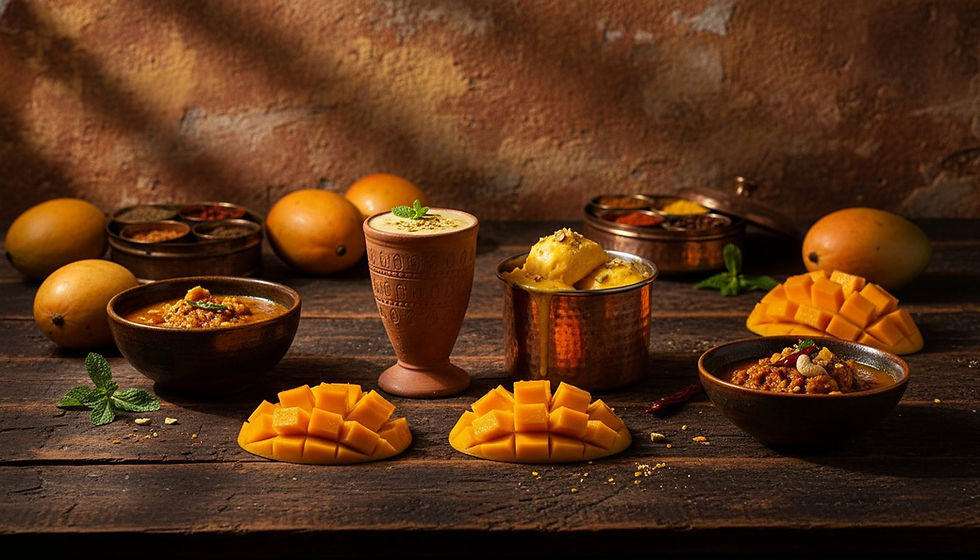
The buffet, in particular, reads like someone asked a kitchen, “How far can you take this?” and the kitchen answered, “Watch us.” The sample menu moves from starters and salads to chaat, mains, rice, breads, desserts, drinks and condiments, all with mango threaded through the meal in different moods and textures. There are options like mango grilled paneer, fresh pakoda with mango chutney, green mango tikki, stir-fry mango baby corn and crispy honey mango soya chaap. Then the whole thing slips into mango avocado salad, mango corn salad, Thai mango salad and even mango pasta salad, because apparently we are not here to be timid. Chaat makes an appearance too, as it absolutely should, with mango chaat and mango pani puri bombs bringing the sort of sweet-tangy-chaotic energy good chaat lives for.
Then come the mains, where things get particularly interesting. Paneer mango curry. Kerala-style mango curry. Mango dal or mango kadhi. Amchuri bhindi. Aloo in tart, punchy variations. Rice, breads, chutneys, pickle, papad, raita. It is the kind of spread that understands Indian food doesn’t have to choose between comfort and surprise. It can be both. It can hand you something familiar and then quietly slide a mango twist into the frame just to keep you on your toes.
And then, because restraint is for other people, the dessert section arrives swinging. Mango trifle, mango mousse, mango phirni, mango tiramisu, mango cake, mango burfi, mango custard. This is not just a buffet. This is a full-scale mango themed buffet Singapore deserves to have when the season rolls in and everyone wants something brighter, juicier and more fun than another ordinary lunch. Add a drink such as aam panha, mango delight or mango peach, and suddenly your afternoon looks considerably better than it did an hour ago.
What I like most about the menu is that it understands mango in all its personalities.
Ripe, Raw and Ridiculously Good

There is the ripe mango version: soft, luxurious, spoonable, impossible not to romanticise. That’s your aam ras, your mastani, your rabdi territory. This is mango at its most indulgent, behaving less like fruit and more like dessert royalty.
Then there is the green mango version: tart, cheeky, sharp-elbowed, great in pickles, chutneys, tikkis and salads. This is the mango that wakes everything up. It cuts through richness. It gives chaat its swagger. It turns a bite from pleasant to addictive.
And between those two poles lies the whole seductive chaos of the mango season. Sweet and sour. Creamy and crisp. Cooling and spicy. Familiar and unexpected.
The À La Carte Pleasures of the Season
That duality is exactly why the à la carte specials work so well too. They give you a more focused way into the season, perfect if you are popping in with family, taking a break from the office, meeting friends over lunch or simply following a deeply personal need for mango desserts in public.
Aam Ras Poori - Summer in Its Purest Form

Take the aam ras. If you know, you know. If you don’t, let me fix that. Aam ras is not merely mango pulp. That description is technically correct and spiritually inadequate. Proper aam ras is velvet. It is chilled sunshine in a bowl. It is the essence of ripe mango stripped of all unnecessary distractions. At Copper Chimney, fresh aam ras is served at the table as part of the buffet, and the à la carte Aam Ras Poori gives that classic pairing its rightful stage: soft puffed puris with luscious chilled mango pulp. It is one of those combinations that sounds improbable until you taste it and realise generations of people could not possibly have been wrong. Sweet, warm, soft, cool, rich, airy. The whole thing is childlike and deeply sophisticated at the same time.
When Mango Crashes the Chaat Party
Then there is mango pani puri, which feels like the sort of idea somebody blurted out at a family table and everybody laughed at until they tried it and went quiet. Mango and pani puri make absurd sense together. The shell shatters, the filling gives way, and then you get that glorious clash of crisp, sweet, sharp and spicy. It’s chaos in one bite. Delicious chaos. The buffet’s mango pani puri bombs and mango chaat lean right into this logic, using mango not as novelty but as a flavour that belongs in the electric, unruly world of Indian street food.
The mango chaat deserves its own little standing ovation. Good chaat should never be polite. It should be noisy with flavour. Tangy, sweet, spiced, crunchy, cooling, maybe a little messy if it’s doing its job. Mango brings an almost mischievous brightness to that mix. It softens heat, sharpens sweetness, plays well with chutneys, and gives the whole thing a tropical lift that makes perfect sense in Singapore’s weather.
And then the drinks. Ah, the drinks.
Mango Mastani: Dessert in Disguise
Mango Mastani is one of those beverages that refuses to behave like a beverage. It is a dessert dressed as a drink, a milkshake that has seen things, a thick luscious tribute to excess in the very best way. Cold, creamy and crowned with indulgent bits, it belongs to that class of treats designed to silence conversation for at least a few seconds. The kind where the first sip produces immediate eye contact and a solemn nod.
When Summer Needs Sparkle
Mango Fizz by contrast, is brighter and friskier. A little sparkle, a little zing, a little lift. The extrovert at the table. The thing you order when the afternoon is humid, the city feels sticky and you want something cheerful enough to reset your mood.
Mango Rabdi and Other Excellent Life Choices

And then there is mango rabdi. Or, more specifically here, Mango Rabdi with Ice Cream and Mango Pearls. Which is not so much dessert as a beautifully orchestrated collapse of self-control. Rabdi on its own is already a rich, reduced-milk dream, dense with comfort and nostalgia. Add ice cream, mango and little bursts of mango pearls and it becomes one of those mango desserts Singapore should not have to settle for once a year but tragically does. Creamy, cold, floral, silky, deeply satisfying. It is the dessert equivalent of saying, “Let’s not do this halfway.”
Why Mango Festival in Singapore Works So Well
And this, really, is why the festival works.
Not because mango is trendy. Mango does not need trends. Mango was beloved before your algorithm discovered tropical aesthetics. It works because the fruit carries emotional and culinary range. It appeals to the nostalgic and the curious. To the person who grew up licking aam ras off their wrists and the person who has never heard the word before but is willing to be converted. To families looking for an easy, cheerful lunch. To office groups wanting something a little different from the usual weekday routine. To those searching for a proper seasonal mango menu Singapore can offer without the whole thing feeling gimmicky.
Made for Families, Office Lunches and the Hopelessly Mango-Mad
Copper Chimney, importantly, does not overplay its hand. It simply gives mango room. Room to show up in starters, in salads, in curries, in drinks, in desserts. Room to be playful. Room to be comforting. Room to be familiar if you know it, and intriguing if you don’t.
That makes it a rather easy place to recommend without sounding like you’re doing sales copy gymnastics. If you’re the sort who plans family lunches around what everyone will actually enjoy, this works. If you’re the designated organiser for office lunches and need something that feels special without becoming logistically tragic, this works. If you are simply a person who hears the phrase mango festival Singapore and instinctively starts clearing your calendar, this definitely works.
An Easy, Sunny Excuse for Lunch
There is also something delightfully democratic about a buffet price that does not ask for drama. Daily from 7pm to 10pm, from 25 April onwards, at $23.90 nett, it is the kind of lunch proposition that invites repeat visits rather than one grand ceremonial outing. Which is just as well, because a mango season worth its salt should never be a one-and-done affair.
Answer the Craving While the Season Lasts
So here is my advice.
Do not overthink it. Do not stand around asking whether mango belongs in chaat, or curry, or a drink, or whether aam ras and puri is too much sweetness for lunch. These are theoretical questions. The mango season has no respect for theorists. It rewards participation.
Go hungry. Go curious. Go with the people in your life who understand food as a form of joy. Or go with the sceptic who still thinks it’s “just a mango” and let the meal do the conversion work for you.
Start with the buffet if you want the full story. Make a round of the starters. Try the mango grilled paneer. Have the mango chaat. Give the mango pani puri a proper chance. Spoon up the curries. Tear bread, mix chutney, repeat as necessary. Leave room for dessert even if you think you cannot. Especially if you think you cannot. And if you are a more focused sort of mango worshipper, order the specials. Get the Aam Ras Poori. Get the Mango Mastani. Get the Mango Rabdi. Get the Mango Fizz. Regret nothing.
Because mango season is not subtle, and neither should you be. The time to give in is while the season lasts
Frequently Asked Questions
When does the mango buffet start?
The mango buffet starts from 30 April onwards. It is a limited-time seasonal offering created to celebrate mango season in all its sweet, tangy and gloriously excessive forms.
What time is the mango buffet available?
The buffet is available daily from 7pm to 10pm, making it an easy option for weekday lunches, catch-ups, family meals and office outings.
What is included in the mango buffet?
The buffet features a wide spread of mango-inspired dishes across starters, salads, chaats, mains, rice, breads, desserts, drinks and condiments. Expect options such as mango grilled paneer, green mango tikki, mango chaat, mango pani puri bombs, paneer mango curry, Kerala-style mango curry, mango trifle, mango mousse, mango phirni and more, with fresh aam ras served at your table.
Are mango desserts and drinks available à la carte?
Yes. The festival also includes à la carte specials and drinks such as Aam Ras Poori, Mango Mastani, Mango Rabdi with Ice Cream and Mango Pearls, and Mango Fizz, so you can drop by for a lighter mango fix without committing to the full buffet.
Where can I enjoy this mango buffet in Singapore?
You can enjoy the seasonal mango festival menu at Copper Chimney in Singapore. It is a lovely option for mango lovers, families, office lunch groups and anyone in the mood for a cheerful seasonal meal built around the king of fruits.

Comments