
The Velvet Revolution: A Connoisseur’s Guide to Authentic Butter Chicken

Updated: Apr 8
If your plate is swimming in a pool of sugary, neon-orange sauce that tastes more like a commercial bottling plant than a North Indian kitchen, you haven't actually eaten butter chicken. It's a common tragedy in our local dining scene. We've all sat at a table, perhaps tucked away in a corner of Little India or a sleek Singaporean food hall, only to be served a cloying, 'ketchup-like' imitation that insults the 1947 Delhi legacy. You're likely tired of the blurred lines between a proper Murgh Makhani and its spicier cousin, the Tikka Masala; you're also probably weary of the constant search for a truly authentic, Halal-certified version that doesn't sacrifice depth for convenience.
This guide will strip away the sugar to reveal the complex, smoky reality of the original Velvet Revolution. You'll learn to identify the hallmarks of a masterfully balanced sauce, understand the non-negotiable role of the Tandoor in providing that essential char, and find a reliable, award-winning source for this Halal-certified classic right here in the city. It's time to demand more from your bowl than just a bright colour and a heavy hand of cream.
Key Takeaways
Uncover the soulful 1950s Delhi origins of butter chicken and understand how a stroke of culinary genius transformed simple leftovers into a global icon.
Understand the alchemy of the Tandoor, where high-heat smoke and precise marinades create that elusive, silk-on-the-tongue texture.
Decode the structural secrets that separate a true Murgh Makhani from its cousins, focusing on the "no-onion" rule and authentic sauce composition.
Develop a connoisseur’s eye for authenticity by spotting the natural ochre colours and charred edges that signal a dish's true Tandoori lineage.
See how Copper Chimney honours this Halal-certified heritage in Singapore, blending rigorous tradition with a deep, personal passion for flavour.
Table of Contents What is Butter Chicken? Beyond the Velvet Curtain The Alchemy of Flavour: Smoke, Spice, and Silk Butter Chicken vs. Chicken Tikka Masala: The Great Debate The Connoisseur’s Checklist: How to Spot the Real Deal The Copper Chimney Philosophy: A Heritage of Flavour
What is Butter Chicken? Beyond the Velvet Curtain
To understand the soul of North Indian comfort food, you have to look past the neon-orange tubs of takeaway. Murgh Makhani, or what most of us call butter chicken, is a masterclass in culinary thrift born from the necessity of 1950s Delhi. It wasn't designed in a laboratory for mass appeal; it was a stroke of genius by chefs at Moti Mahal who refused to let leftover tandoori chicken go to waste. They needed a way to rehydrate meat that had spent too long in the 480°C heat of a clay oven, and the solution changed the culinary world forever.
By simmering those dry, charred pieces of poultry in a rich tomato and butter gravy, they birthed a global icon. If you dig into the history of butter chicken, you find a story of survival and innovation that transformed a humble Punjabi kitchen into a worldwide phenomenon. It's about the emulsion, the way fat and acid dance together, rather than just a slab of dairy thrown into a pot. The name is often deceptive to the uninitiated, suggesting a greasy indulgence, but the reality is a sophisticated balance of flavours that has conquered palates from the streets of Punjab to the high-end dining rooms of Singapore.
The visceral appeal of this dish lies in its ability to satisfy a deep, primal craving for warmth and richness. It's a culinary hug that transcends borders. Whether you're sitting in a bustling Hawker centre or enjoying a refined meal at Copper Chimney, the first spoonful of that silk-textured sauce tells a story of heritage. For over 12 years, we've watched guests in Singapore light up at that first bite, proving that while the world changes, our love for a perfectly executed Makhani remains a constant.
The Anatomy of a Legend
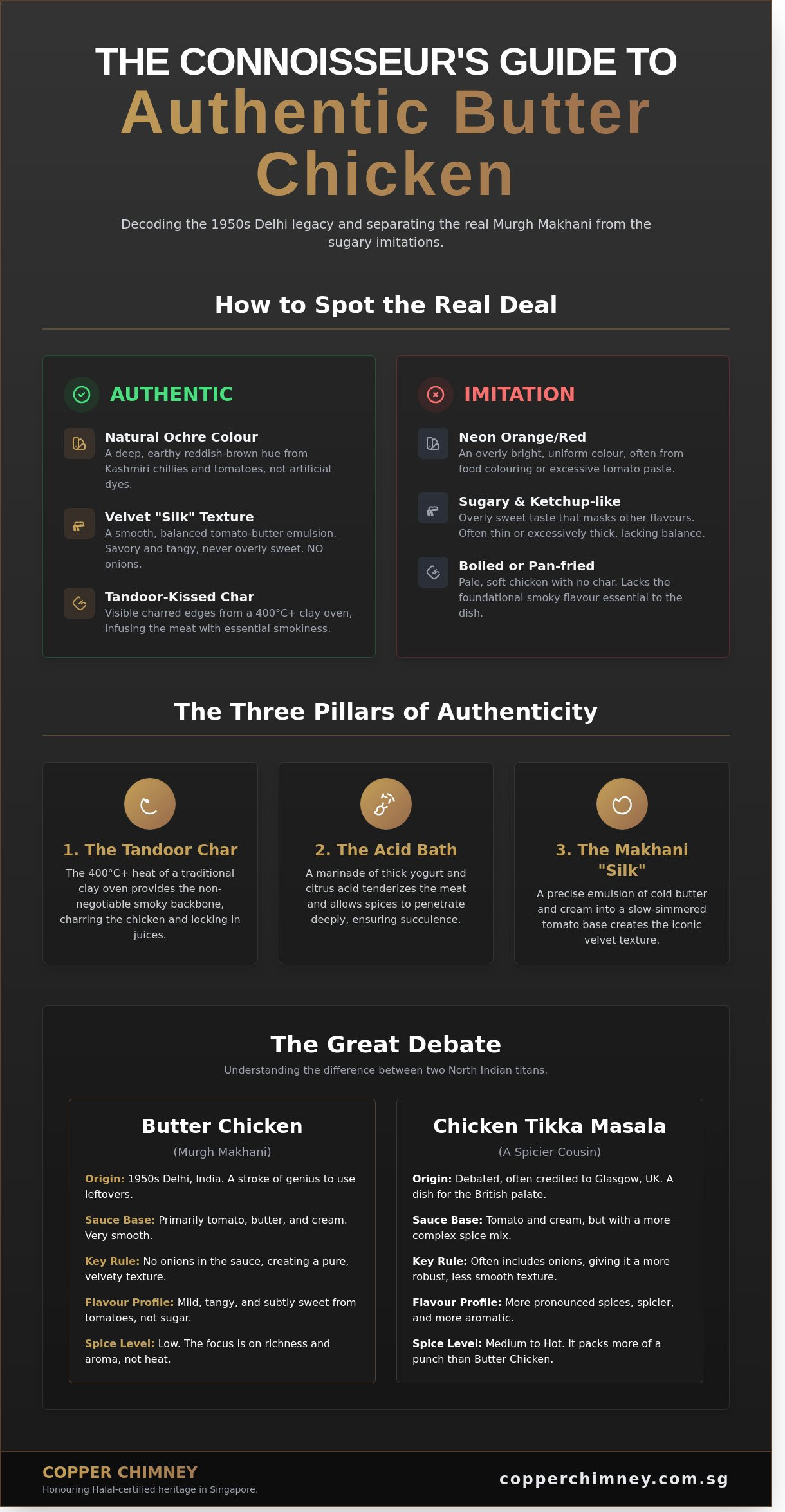
True butter chicken relies on three non-negotiable pillars: the tandoor-kissed char, the sharp tomato base, and the silk. Many modern versions fail because they lean on excessive sugar; sweetness is the enemy of an authentic profile. The natural acidity of the tomatoes must be balanced by cold-pressed butter and heavy cream, not syrup. The Makhani sauce serves as a culinary canvas, capturing the smoky essence of the meat and holding it in a velvet grip that lingers on the tongue long after the meal is over.
Murgh Makhani vs. The World
This dish stands apart from the heavy, oil-laden curries that often dominate the perception of Indian cuisine. It's lighter on the palate but deeper in soul than a standard Tikka Masala. In Singapore, where we serve a diverse community of food lovers, the Halal distinction is a vital marker of trust and inclusivity. It ensures that every guest can enjoy this heritage without reservation. Murgh Makhani is a balance of smoke-infused chicken and a velvet-textured tomato reduction.
The Alchemy of Flavour: Smoke, Spice, and Silk
To truly understand butter chicken, you have to understand the fire. It begins in the belly of a Tandoor, a traditional clay oven where temperatures regularly climb above 400 degrees Celsius. This isn't just about raw heat; it's about the visceral, smoky char that only a coal-fired pit can provide. This smokiness acts as the backbone of the dish, cutting through the richness that follows. Without that initial trial by fire, the dish is just a tomato stew.
Before the bird meets the flame, there's the bath. A marinade of thick, hung yogurt and citrus acid is non-negotiable. The yogurt acts as a gentle tenderiser, while the acid ensures the spices penetrate deep into the meat. While many enthusiasts might follow a Classic butter chicken recipe at home, the professional edge comes from the balance of this soak. It ensures the chicken remains succulent even after the intense blast of the Tandoor.
Then comes the silk. True butter chicken achieves a signature sheen that feels like velvet on the tongue. This isn't about dumping excessive grease into a pan. It's a precise emulsion of cold butter and heavy cream into a tomato base that's been simmered until the raw edge of the fruit has vanished. At Copper Chimney, we've refined this process over the last 12 years in Singapore, ensuring every bowl meets our Halal-certified standards of excellence.
The Secret Language of Spices
Kashmiri Chilli: This is a visual lie. It provides a vibrant, sunset-red colour that suggests a heat it never actually delivers. It's all about the glow, not the burn.
Kasuri Methi: These dried fenugreek leaves provide a haunting, floral finish. It’s the scent of a Delhi alleyway at dusk, crushed between the palms at the very last second.
Garam Masala: This is the warming heartbeat of the sauce. It's a complex blend of cardamom, cinnamon, and cloves that ties the disparate notes into a single, cohesive narrative.
The Professional Kitchen Advantage
Home stoves simply lack the horsepower. A domestic oven won't hit those 400-degree marks required for the perfect Tandoori char. We employ a 'double-cook' method where the chicken is roasted first in the clay oven, then finished in the simmering gravy. To achieve that legendary 'silk' texture, the sauce is passed through a fine chinois. This technical, labour-intensive step removes every stray seed or skin. If you're craving that authentic, award-winning texture tonight, you can order our signature version online and experience the difference for yourself.
Butter Chicken vs. Chicken Tikka Masala: The Great Debate
Sit down at any table in Singapore and you'll see the struggle play out. It's a visual toss-up between two icons of the tandoor. One represents the refined soul of Old Delhi; the other is a gritty, beautiful hybrid born in the rain-slicked streets of the UK. Choosing between them isn't about better or worse. It's about what your soul needs at 8:00 PM on a Tuesday. While the uninitiated might see two orange bowls and assume they're identical siblings, they're actually distant cousins with very different passports and personalities.
Mapping the Flavour Profiles
The butter chicken we serve is a love letter to 1948 Delhi, specifically the kitchen of Kundan Lal Gujral. It's subtle. It's a tomato-forward embrace softened by cold cubes of butter and heavy cream. The flavour is elegant and rounded, leaning into the natural sweetness of the tomatoes. Chicken Tikka Masala is the rebellious offspring, allegedly born in a Glasgow kitchen during the 1970s when a customer found his meat too dry. It's bolder and more aggressive. It hits you with a sharp, acidic tang from a base of sautéed onions and a heavy-handed spice blend that demands your attention. If the former is a silk scarf, the latter is a leather jacket.
The Texture Test
The real test lies in how the sauce feels against your palate. A true Makhani sauce is strained until it's liquid silk. If you find a piece of diced onion or a chunk of ginger, you aren't eating an authentic version of this dish. You're eating a pretender. Chicken Tikka Masala celebrates the chunky bits; the onions and peppers provide a structural resistance that pairs perfectly with a charred Garlic Naan. For those exploring the wider landscape of these traditions, The Ultimate Guide to Authentic Indian Food in Singapore offers a deeper dive into how these legends sit in our local culinary tapestry.
Which one should you order? It depends on your mood:
Choose butter chicken when you want a velvety, comforting hug that highlights the creaminess of the sauce.
Go for Chicken Tikka Masala when you're craving something punchy, robust, and unapologetically spiced.
At Copper Chimney, we respect the history of both. In a 2017 survey, Chicken Tikka Masala was still ranked as one of the most popular dishes globally, but in the heart of our Singapore kitchen, the authentic makhani remains the undisputed king of comfort. We keep our recipes 100% Halal-certified, ensuring that every guest can partake in this visceral experience of Northern Indian heritage. Whether you want the silk or the spice, the choice defines your evening.
The Connoisseur’s Checklist: How to Spot the Real Deal
Finding a bowl of authentic butter chicken in a city as food-obsessed as Singapore is easy; finding one that speaks to the soul is a different pursuit entirely. You don't just look at the menu; you look for the markers of a kitchen that respects the craft. A true connoisseur knows that the first sign of trouble is a neon red hue that looks more like a highlighter than a curry. Authentic versions lean toward a natural ochre or a deep, sunset orange, derived from the marriage of ripened tomatoes and Kashmiri chillies rather than a bottle of food colouring.
The chicken tells its own story. Look for the char. If those edges aren't blackened and blistered from a 400-degree Celsius Tandoor, the meat likely hasn't seen the inside of a clay oven. You want those smoky, carbonised whispers to cut through the richness of the gravy. Then, there is the aroma. Before the spoon even reaches your lips, a heady hit of toasted fenugreek and charcoal smoke should hit you. It's a visceral reminder that great food requires fire and patience.
The Colour: Deep ochre and warm orange tones, never artificial neon red.
The Char: Visible blackened edges on the meat from intense Tandoor heat.
The Consistency: A sauce that clings to the spoon with velvety persistence.
The Aroma: An immediate, fragrant punch of dried fenugreek leaves (Kasoori Methi).
Evaluating the Sauce
Balance is the ultimate test of a chef's restraint. The acidity of the tomatoes must sing through the cream, providing a sharp counterpoint to the dairy. If it tastes like a dessert, it's been drowned in sugar to mask poor ingredients. The cream integration must be flawless. A perfect sauce is a seamless emulsion that carries the weight of the spices without feeling heavy on the tongue. At Copper Chimney, our award-winning recipe ensures the fats and spices never split into an oily mess.
The Meat of the Matter
Texture is where many kitchens fail. We use boneless chicken thigh because it retains its succulence under the brutal heat of the Tandoor, whereas breast meat often turns to sawdust. A 24-hour yogurt marinade breaks down the fibres, ensuring every bite is tender. You might notice the gritty reality of a kitchen that produces soulful results, the tiny flecks of spices and charred bits that prove this wasn't made in a factory. It's the mark of a dish that has been handled by human hands since our first Singapore outlet opened in 2012.
Experience the gold standard of North Indian flavours and
for a taste of true culinary heritage.
The Copper Chimney Philosophy: A Heritage of Flavour
There is a certain honesty in a Tandoor oven that you won't find in modern convection gadgets. It is a primal, soot-stained beast that demands respect. At Copper Chimney, we've spent more than 12 years perfecting the North Indian Tandoori tradition, treating the clay oven not just as a tool, but as the soul of our kitchen. This is where the story begins. It’s about the heat, the char, and the inherited wisdom of chefs who know exactly when the charcoal has reached its peak. We don't believe in shortcuts because tradition doesn't have a fast-forward button. Our approach is a deliberate nod to the past, ensuring that every plate of butter chicken we serve carries the weight of history alongside its velvety texture.
We see our restaurant as a bridge. On one side, there is the gritty, aromatic history of the Punjab; on the other, the polished, fast-paced reality of modern Singapore. Bridging that gap requires more than just a recipe. It requires a philosophy that values the 'smoke' as much as the 'silk'. When you sit at our table, you’re tasting a decade of refinement and a lifetime of cultural pride. It’s a sensory journey that starts in the heat of the kitchen and ends with the quiet satisfaction of a meal well-made.
Crafting the Signature Dish
The magic of our Makhani reduction lies in the patience of the simmer. Our seasoned chefs, many of whom have helmed our kitchens since 2012, hand-craft the base by reducing tomatoes and spices until the flavours are concentrated and intense. It is a slow-motion alchemy that transforms raw ingredients into a silk-smooth gravy. This dedication to craft is what defines our place in the local landscape, as explored in our guide to The Soul of the Spice. We balance that nostalgic richness with modern culinary precision, ensuring that the 'smoke' from the Tandoor meets the 'silk' of the cream in perfect harmony.
The Halal Assurance
In a city as beautifully diverse as Singapore, hospitality means nothing if it isn't inclusive. Our Halal certification is more than a regulatory requirement; it’s a fundamental part of our culinary storytelling. It ensures that when we invite you to our table, you aren't just a customer, you’re an invited guest who can dine with absolute peace of mind. Authenticity and inclusivity go hand-in-hand here. We’ve found that the best meals are the ones where everyone has a seat. Whether you’re a lifelong fan of butter chicken or a curious traveller, we invite you to step out of the Singapore heat and into our world of smoke and silk. The fire is ready, and the heritage is on the plate.
Savour the Soul of the Tandoor
There's a certain honesty in a dish that refuses to take shortcuts. Authentic butter chicken isn't just about the cream; it's about the battle between the fierce heat of a 400-degree Tandoor and the cooling grace of a well-balanced, silken gravy. You now know the markers of the real deal, from the subtle kiss of smoke to the firm rejection of those overly sweet, mass-produced imposters often found in lesser kitchens. At Copper Chimney, we've spent years perfecting this craft, leaning on award-winning heritage recipes that have defined our place in Singapore's culinary landscape since we first opened our doors.
Our Halal-certified kitchen remains a sanctuary for those who crave the genuine article, prepared with the same soulful intensity that first made the dish a global icon. We don't believe in compromise when it comes to flavour. Every piece of chicken is hand-crafted and charred to perfection, ensuring the velvet texture you've read about is exactly what lands on your plate. It's time to stop reading and start eating. Indulge in the velvet smoke of our signature Butter Chicken at Copper Chimney and experience the heritage of North Indian excellence for yourself. Your table is ready.
Frequently Asked Questions
Is Butter Chicken supposed to be spicy or sweet?
Authentic butter chicken is defined by a mild, creamy profile that balances tangy tomatoes with a hint of sweetness rather than aggressive heat. It's a dish of nuance, where the Scoville scale takes a backseat to the silkiness of the makhani gravy. While it carries a gentle warmth from Kashmiri chillies, it shouldn't leave you gasping for water. It's the culinary equivalent of a velvet glove, designed for comfort and depth.
What is the difference between Butter Chicken and Murgh Makhani?
There is no functional difference between the two; Murgh Makhani is simply the traditional Hindi name for butter chicken. Murgh translates to chicken and Makhani refers to the buttery sauce that defines the dish. Whether you're in a high-end bistro or a roadside dhaba, you're looking for that same holy trinity of tandoor-grilled poultry, tomatoes, and cold-pressed butter that has defined North Indian excellence since the 1950s.
What are the best side dishes to pair with Butter Chicken?
Garlic naan and fragrant Jeera rice are the undisputed champions for soaking up every drop of that liquid gold. The charred, blistered edges of a fresh naan provide the necessary structural integrity to scoop up the heavy gravy. If you're feeling adventurous, a side of crisp onion bhajis or a refreshing kachumber salad adds a much-needed crunch and acidity to cut through the richness of the 15 percent fat cream content.
Is Butter Chicken always Halal in Singapore?
While butter chicken is common across the island, it isn't universally Halal-certified in every Singaporean establishment. At Copper Chimney, we ensure our entire menu meets strict MUIS Halal standards to serve our diverse community of food lovers. This certification is a pillar of our 12-year legacy in Singapore, providing peace of mind for our guests. Always check for the official green MUIS certificate displayed at the storefront before you sit down to dine.
Why is my Butter Chicken sauce sometimes grainy?
A grainy texture usually stems from skipping the crucial step of straining the tomato puree through a fine-mesh sieve. To achieve that legendary velvet consistency, the sauce must be silky, not gritty. Another culprit is adding cold cream to a boiling pot, which can cause the fats to separate. Professional chefs emulsify the sauce at a steady 80 degrees Celsius, ensuring the dairy integrates perfectly with the aromatic spices without breaking the emulsion.
Can Butter Chicken be made healthy without losing the flavour?
You can certainly lighten the dish by substituting heavy cream with low-fat Greek yoghurt or a smooth cashew paste. Reducing the butter content by 50 percent and using skinless chicken breast also cuts the calorie count significantly without sacrificing the soul of the spices. While it won't be the decadent indulgence found in our kitchen, it's a respectable way to enjoy those aromatic North Indian flavours during a weekday lunch.
What makes the Copper Chimney version unique among others?
The Copper Chimney version stands apart because of our commitment to the 24-hour marination process and our custom-built clay Tandoors. We don't just cook the chicken; we infuse it with a smoky depth that contrasts beautifully with our secret blend of 12 spices. This dedication to craft has earned us multiple culinary awards over the last decade, cementing our reputation as a custodian of authentic, high-end North Indian and Chindian flavours in Singapore.
Is it better to eat Butter Chicken with Naan or Biryani?
Naan is the purist's choice for butter chicken because its soft, chewy texture is the perfect vessel for the thick makhani gravy. However, pairing it with a vegetable biryani adds a complex layer of aromatics that can elevate the meal to a celebratory feast. In our experience, 70 percent of diners prefer the simple elegance of a butter naan, while those seeking a more robust, spice-forward experience often opt for the rice.


Comments